In the winter of 1880–81, the trains stopped coming to De Smet, Dakota Territory, and didn’t run again until May.
Blizzards rolled in one after another. The stores emptied out. Laura Ingalls Wilder later wrote about her family grinding seed wheat in a hand coffee mill for bread and twisting prairie hay into sticks to burn once the coal was gone. People still call it the Hard Winter.
What strikes me isn’t how close they came to the edge. It’s that everyone understood the rule: whatever wasn’t in the house by first snow might not exist until spring.
We’ve mostly forgotten that rule. Here’s what pioneer families put away before winter, why each item mattered, and how to build the same kind of cushion in a modern pantry.

1. Flour, Grain and Cornmeal
Bread was the backbone of the winter table, so grain came first. Families milled what they grew or hauled flour home while the roads were still open. Once snow closed the trails, there was no running to town for one more sack.
De Smet shows what happens when that cushion runs short. When the flour gave out, the seed wheat set aside for spring planting went into the coffee mill. Grinding by hand was slow work, and somebody was at it most of the day.
The modern version: Whole wheat berries keep for years in sealed buckets, far longer than flour, but whole grain is only food if you can grind it. A manual grain mill turns a bucket of wheat into bread. Without one, that bucket is just a heavy doorstop.
How long would the flour in your kitchen last right now if nobody could get to the store? For most of us, your honest answer is probably a couple of weeks, if that.
2. Potatoes and Root Crops, Cured Before the Cellar
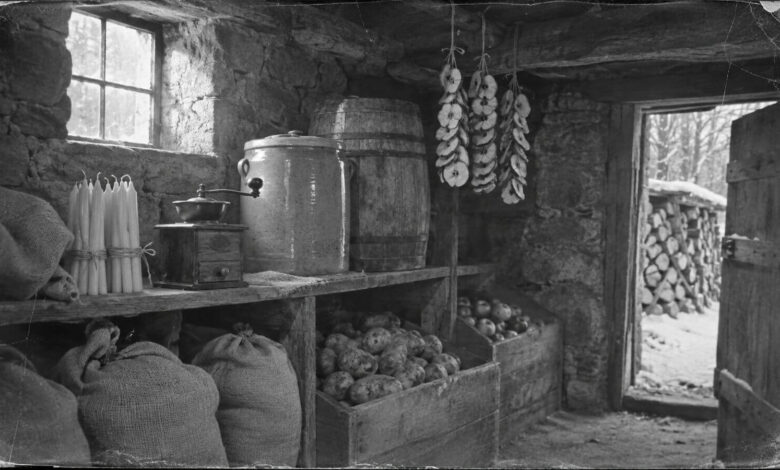
The root cellar was the pioneer refrigerator, and potatoes were its main tenant. Carrots, beets, turnips and cabbage filled the rest. Some families dug into a hillside; others cut a “potato hole” into the cabin floor so they wouldn’t have to wade through snow to reach supper.
They didn’t just toss the harvest underground. In North Dakota, settlers piled freshly dug potatoes in the field under straw and dirt for a while before moving them to the cellar. That rest toughened the skins for the long haul. Modern storage science says the same thing in different words: let them cure first.
The modern version:
- Cure potatoes at 50 to 60°F with high humidity for about two weeks so small cuts heal.
- Then store them in the dark at about 40°F and 90 to 95% humidity.
- Pack carrots in slightly damp sand so they don’t touch each other.
- Keep the space small and full. Extension guidance says a 4-by-6-foot room covers most families, and a full cellar holds its humidity better than a big, empty one.
If your potatoes go soft and sprout in a warm kitchen cabinet by Christmas, warmth and light are why.
You don’t need a hillside. An unheated corner of a basement, walled off and kept dark, does a surprising amount of what a pioneer cellar did.
3. Apples, Some Fresh and Most Dried
Apples were the one sweet thing a farm family could count on all winter, and they kept them two ways.
The best keepers went into the cellar, often buried in sawdust. Most of the rest got sliced and dried.
In Pennsylvania German country, those dried slices are called schnitz. Farm wives dried them on racks in the brick bake oven once the day’s bread came out, using the heat that was left. Come January, schnitz turned into pies and into schnitz un knepp, a ham-and-dumpling dish that still turns up at church suppers around here.
Here’s the part people get wrong. Apples don’t belong next to your vegetables. They give off ethylene, a natural ripening gas that can turn stored carrots bitter and push potatoes to sprout, and potatoes in turn make apples taste musty. In our cellar, the apples sit on their own shelf on the far wall, well away from the potato bins.
The modern version: Dry apples in a dehydrator or a low oven at about 140°F until they’re leathery. Stored airtight, they take up a fraction of the space of fresh fruit and don’t care whether the power is on.
4. Dried Beans and Dried Corn
If root crops were the bulk of the winter diet, beans and corn were the insurance.
Dry beans need nothing but a dry container. Pennsylvania Dutch households shelled their extra sweet corn at harvest, dried the kernels in the sun and stored them for winter cooking. That jar of dried kernels meant a taste of summer on the table when the garden was under two feet of snow.
The modern version: Beans are still one of the cheapest calories you can store, but they don’t stay perfect forever. Utah State University Extension notes that their vitamins start to break down after two to three years. Very old beans can also get so hard they won’t soften no matter how long you cook them.
So store your beans airtight and cool, and cook from your stash every few weeks. If you can’t remember when you bought the bag in the back of your pantry, cook it this month. That’s how a farm kitchen worked anyway. Nobody bought a bag of beans to look at.
5. A Crock of Sauerkraut
Every German farmhouse in Pennsylvania had a crock or a barrel of kraut working in the cellar by late fall. Shredded cabbage and salt, pressed down and left to sour.
It wasn’t only about flavor. Winter meant weeks with no fresh greens, and sauerkraut was one of the few foods that carried a bit of vitamin C into the dark months. Captain Cook carried it to sea to fight scurvy for the same reason.
Pork and sauerkraut on New Year’s Day is still a Pennsylvania tradition, and I’d bet most families who eat it have no idea it started as a survival habit.
The modern version: Fermenting is easy, but it’s a food-safety process, not a guessing game. Use a tested recipe, such as the one from the National Center for Home Food Preservation. Get the salt ratio right and keep the cabbage under the brine. If you’ve never fermented anything, a half-gallon jar on your counter is a fine place to start. You’ll learn more from one jar than from ten videos.
6. One Hog: the Pork Barrel and the Lard Crock
Meat was the hardest thing to keep, so families waited for the cold to do part of the work. Hog butchering happened in late fall or early winter, once the nights stayed reliably cold, often below 40°F for several days running. Whole neighborhoods turned out to help.
Nothing went to waste. Hams and bacon were salted or smoked. Slabs of pork were rubbed with salt and packed into barrels under brine, and that salt pork flavored beans and stews until spring. The fat went into big iron kettles and came out as lard, the cooking fat for the whole year. Nana Ruth never let a spoonful of fat go down the drain, and I suspect her mother didn’t either.
The modern version: Lard is worth stocking. Homemade lard keeps for months in a cool, dark spot and longer in the refrigerator or freezer. Throw it out if it smells sharp or sour. If you buy pork from a local farm, ask them to save the fat for you, and you can render your own on the stove.
Curing meat is a different story. Don’t cure pork from memory or from a forum post. Done wrong, it can make people seriously sick. Follow a tested extension recipe to the letter, or buy cured and canned meats and rotate them.

7. Light for the Long Nights
People forget about light until it’s gone. By December, a farm family could spend fourteen hours a day in the dark.
Late autumn was candle season. Summer was too warm for tallow candles to set properly, so families rendered beef fat and dipped or molded a winter’s worth once the weather cooled. Later came kerosene lamps, which is why so many accounts of the Hard Winter mention running short of lamp oil along with coal and flour.
This is one place I’d break with the old ways. A house full of open flames was a real fire risk then, and it’s a worse one now, with drapes, carpets and kids. Emergency agencies are blunt about it: use flashlights or battery lanterns in an outage. If you must burn a candle, put it in a sturdy holder away from anything that can catch fire, and never leave it unattended.
The modern version: LED lanterns, a headlamp for everyone in the house and a stock of batteries. Do the math the way a pioneer mother would: about 14 dark hours a night, times however many nights you might go without power.
[BANNER 6 HERE]
8. Firewood, More Than You Think
I saved this one for last because it was the one that could kill you.
The numbers are hard to believe. Historians estimate that a colonial household burned 30 to 40 cords of wood a year, and a cord is a stack 4 feet high, 4 feet deep and 8 feet long. Even by the 1850s, after better stoves arrived, a northern farm still went through around 15 cords.
Neighbors judged a man’s thrift partly by the size of his woodpile, and that wasn’t snobbery. Colonial letters and diaries describe families who ran out and burned their furniture to keep from freezing. In De Smet, when the coal was gone, people twisted hay into sticks.
Now ask yourself something uncomfortable. If your furnace stopped tonight and stayed off for two weeks, what would keep your family warm?
The modern version:
- If you have a wood stove or fireplace, get dry, seasoned wood stacked and covered before the first snow, not after.
- If you don’t, plan a safe backup: a heater rated for indoor use, plenty of blankets, and one small room you can close off and keep warm.
- Never heat the house with a gas oven, a grill or a camp stove. They put out carbon monoxide, and it can kill your family while they sleep.
How Worried Should You Be?
Most winter outages last hours or a few days, not months. You probably won’t be grinding seed wheat in a coffee mill.
But an ice storm that keeps the roads closed for a week is a real possibility in a lot of the country. In a storm like that, the families who come through fine are the ones who did what the pioneers did: filled the shelves in the fall and stopped counting on the store.
The Pioneer Rule Still Works
Pioneer families didn’t have better gear than we do. They had a better habit: winter was something you got ready for in October, not something you shopped for during the storm.
Start small this week:
- Count how many days of meals your pantry could actually make.
- Buy one sealed bucket of beans or rice and one of flour or wheat.
- Check your flashlights and batteries before you need them.
- Pick the warm room your family would close off if the heat went out.
None of it is hard. It’s just the old habit of getting ready early, and it’s worth bringing back.
What did your grandparents always put up before winter, and do you still keep any of it?
The Video Every Prepper’s Talking About: