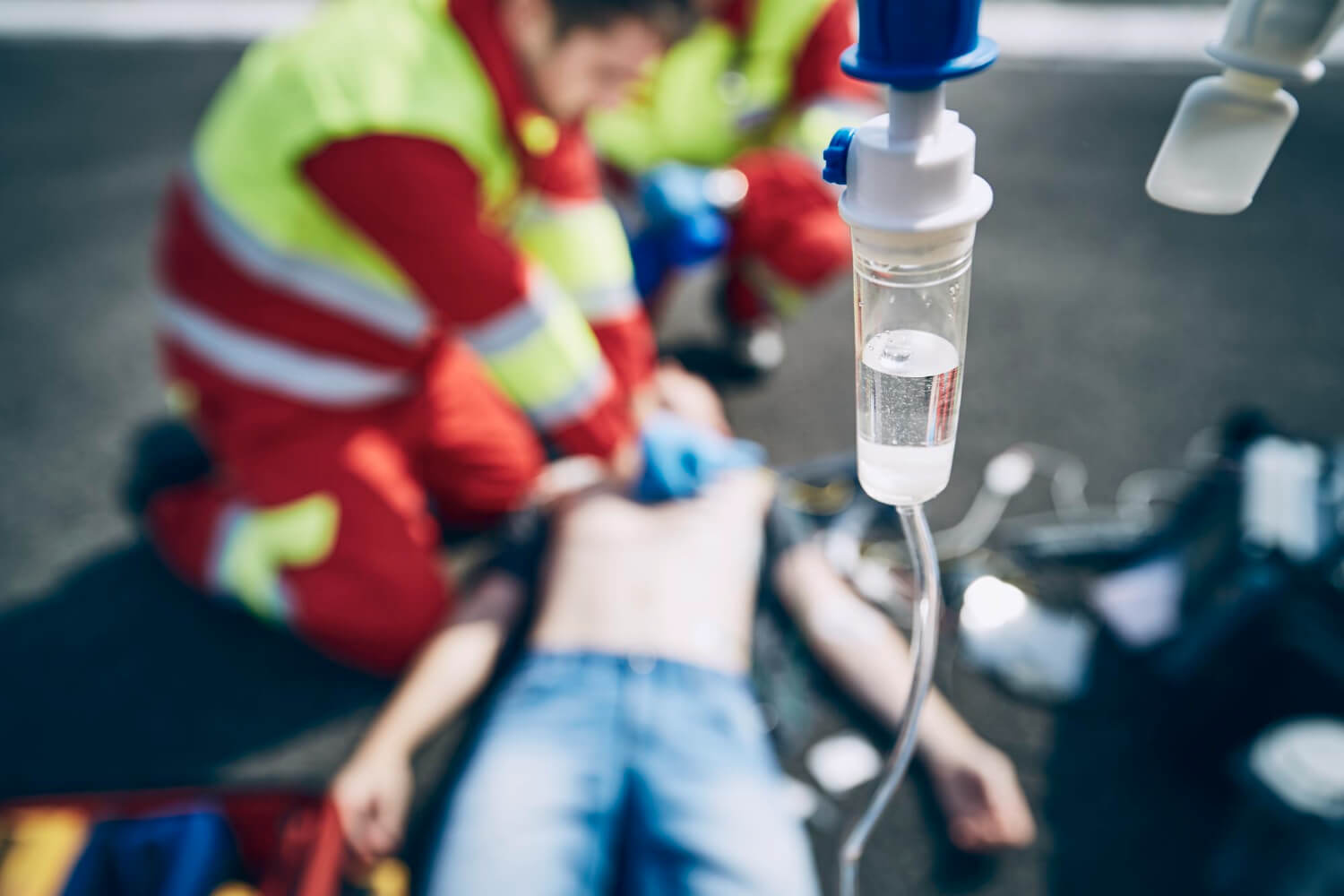
Your survival is currently outsourced to a system designed for statistics, not individuals. In a mass casualty event or a remote accident, the “Golden Hour”, the window where medical intervention can reliably save a life, is an administrative fiction. Emergency response times in urban centers are climbing as infrastructure bottlenecks; in rural areas, they are effectively non-existent during a crisis. While you wait for a siren, the human body can bleed out in less than three minutes. This means the person standing next to you, or your own reflection in the mirror, is the only medical professional that matters. Modern medicine has conditioned you to be a passive bystander, a role that becomes a death sentence when the grid experiences even a minor hiccup. You are currently operating under the illusion of a safety net that is actually a sieve.

Institutions do not prioritize your individual pulse; they prioritize the management of the crowd. When the 911 system is overwhelmed, calls are queued by cold algorithms. If your emergency happens during a storm, a riot, or a localized collapse, you are not a patient; you are a data point in a backlog. Mastery of trauma skills for non-medics is the only way to opt-out of this gamble.
Arterial Hemorrhage: The Three-Minute Clock and the Windlass
The most common preventable cause of death in trauma is uncontrolled bleeding. When a major artery is severed, the heart acts as a high-pressure pump emptying your life onto the pavement. You cannot wait for an ambulance that is ten minutes away when you have 180 seconds of consciousness remaining. Proper intervention requires mechanical occlusion, not a “wait and see” approach with a kitchen towel. Most people assume a bandage is enough; it isn’t. Arterial pressure is high enough to push through standard dressings, soaking them in seconds and masking the continued loss of volume.
To survive, you must understand the Arterial bleeding control mechanism of the windlass.
- The Tourniquet Fallacy: Most improvised tourniquets, belts, neckties, or ropes, fail because they cannot generate the $80-120 mmHg of circumferential pressure required to stop arterial flow. They merely slow venous return, actually increasing blood loss by allowing blood in but preventing it from leaving.
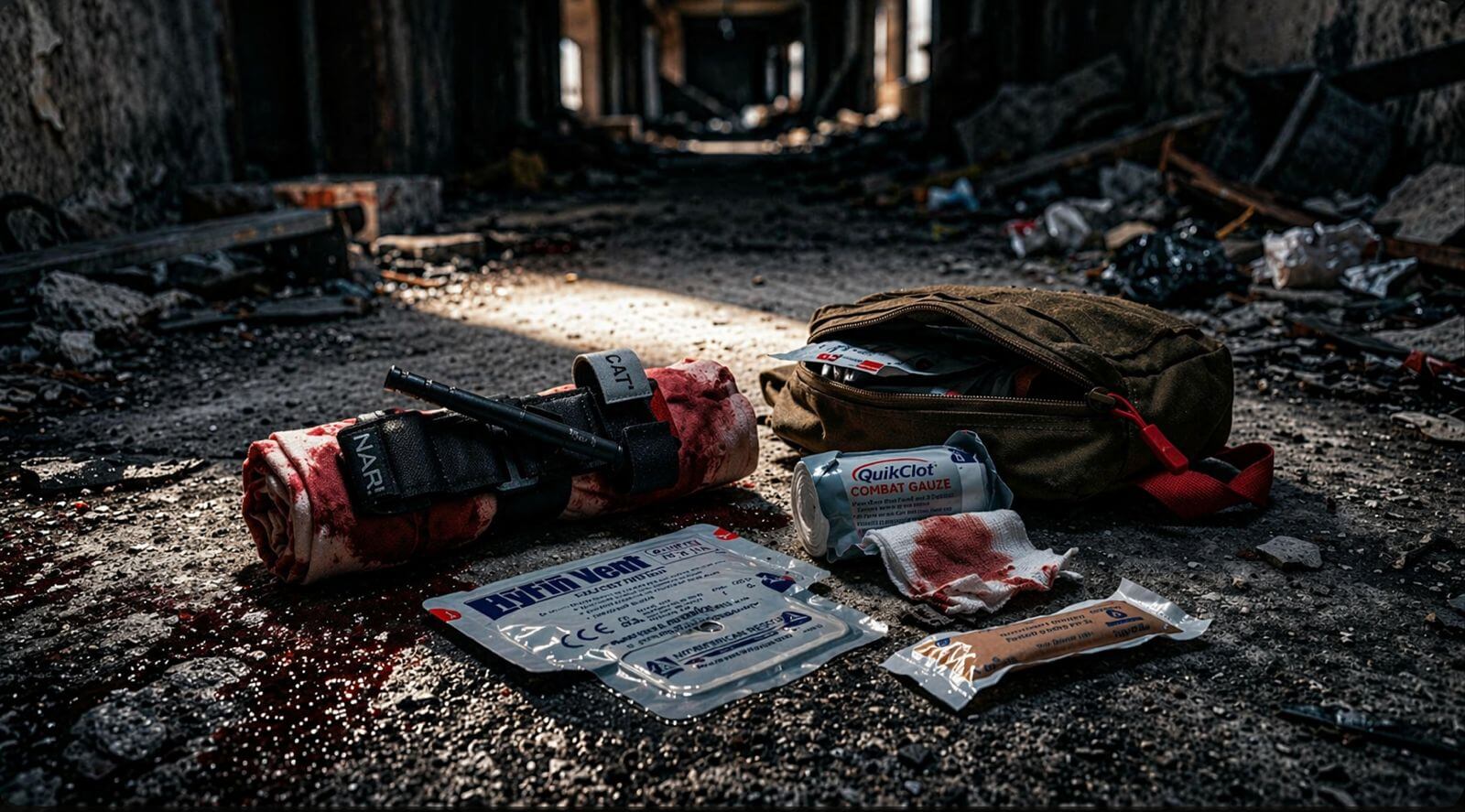
- The Mechanical Solution: You must use a dedicated, Combat-Proven Tourniquet (CAT). It utilizes a rigid windlass to twist the internal strap until the pulse disappears. If the application doesn’t cause excruciating pain, it isn’t tight enough to stop the artery.
- Placement Strategy: In a “high and tight” chaotic environment, the tourniquet goes over the clothing, as high on the limb as possible. You do not have time to look for the wound in a dark or crowded room.
Owning a North American Rescue CAT Gen 7 is not a hobbyist choice; it is the difference between a controlled situation and a fatality. Stashing one in your glovebox and another in your home kit removes your dependency on a fragile 911 dispatch system. Every second spent “making do” with a belt is a second closer to irreversible hypovolemic shock.
The Invisible Killer: Tension Pneumothorax and Atmospheric Pressure
A hole in the chest wall, whether from a puncture, a fragment, or a high-velocity impact, is more than a wound; it is a mechanical failure of the respiratory system. The human chest operates on negative pressure. When that seal is broken, the atmosphere rushes in. This creates a “sucking chest wound” where air enters the pleural space but cannot escape, building pressure that eventually collapses the lung and shifts the heart, kinking the Great Vessels. This is a tension pneumothorax.
This is an invisible killer because the victim may appear stable for several minutes before their vitals plummet. You cannot “bandage” this with standard gauze. Traditional dressings allow air to be sucked in, accelerating the collapse.
Survival depends on a Vented Chest Seal application. These devices act as a one-way valve, allowing air to escape the chest cavity while preventing more from entering. If you are relying on plastic wrap and duct tape, you are gambling with a seal that will likely fail as soon as the patient moves, sweats, or bleeds. Professionals use HyFin Vent Chest Seals because they are engineered to adhere to blood, sweat, and hair. Without these in your trauma kit, you are a witness to a respiratory arrest you are powerless to stop. The system is not coming to vent a chest in the field; if you don’t seal the “box,” the victim will suffocate while their heart is still beating.
Junctional Trauma and the Necessity of Emergency Wound Packing
Tourniquets only work on limbs. If the injury is in the “junctions”, the groin, armpit, or neck, there is no limb to cinch. These are junctional wounds, and they are notoriously difficult to manage without specific tools. Blood will pool internally, and the victim will go into shock while you apply useless surface pressure. In these zones, the only solution is aggressive, deep emergency wound packing.
You must manually jam gauze into the wound track, seeking the bone or the source of the rupture, and hold it with your full body weight. Standard cotton gauze is insufficient because it does not aid in clotting; it merely absorbs. In a high-stress environment, you need a hemostatic agent, a chemically treated gauze that initiates the clotting cascade on contact.
QuikClot Combat Gauze is the industry standard for a reason. It uses kaolin to stop bleeding significantly faster than plain gauze. In a scenario where multiple people are injured and you must move to the next victim, you cannot afford to hold manual pressure for twenty minutes. Hemostatic gauze buys you time and increases the survival rate of wounds that are otherwise “un-fixable” in the field. If your kit only contains Band-Aids and alcohol wipes, you are essentially carrying a toy box to a gunfight.
The Systematic Failure of the “Just-in-Time” Medical Supply
The current supply chain for medical Grade-A equipment is optimized for just-in-time delivery to hospitals, not your home. During a period of civil unrest, natural disaster, or supply disruption, these tools vanish from the market instantly. The “I’ll get it when I need it” mentality is a logical fallacy; when you need a tourniquet, the stores are closed and the roads are blocked.
The institutional response to a crisis is to secure their own perimeters first. Police and EMS will not enter a “warm zone” until it is declared safe, which can take hours. During that window, you are the only Tier 1 responder available. If you have not invested in a Stop the Bleed kit, you have accepted a role as a casualty rather than a survivor.
True autonomy means having a Personal Trauma Kit (IFAK) that contains:
- Two CoTCCC-recommended Tourniquets: One for use, one for a backup or a second limb.
- Twin-pack of Vented Chest Seals: For entry and exit wounds.
- Two packs of Hemostatic (QuikClot) Gauze: To stop junctional bleeds that a tourniquet can’t reach.
- Pressure bandages (Israeli Style): To maintain pressure once the bleeding is controlled.
The Psychological Liability of the Unprepared
The greatest danger in a crisis is not the wound itself, but the paralysis of the witness. When you realize you do not have the tools to save someone you love, the psychological impact is permanent. This is the “exposure” no one talks about, the realization that you were capable of acting but chose to remain dependent on a system that was never designed to save you in the first place.
Modern society has outsourced basic biological survival to a 3-digit phone number. This has created a population that is biologically fragile. Every minute you spend without these items is a minute you are gambling with the lives of your family. Systems fail. First responders get overwhelmed. Gravity and biology do not wait for a convenient time to strike. Your vulnerability is a choice you are making every second you remain unequipped.
The Reality of Prioritization
In a mass casualty incident, the first thing that happens is the suspension of normal care. Responders use a system called START (Simple Triage and Rapid Treatment). If they find you and you aren’t breathing, and a simple airway adjustment doesn’t fix it, they move on. They do not perform CPR. They do not stay with you. They “Black Tag” you and keep walking.
The only way to stay in the “Red” (Immediate) or “Yellow” (Delayed) category is to have already stabilized the life-threatening issues before they arrive. If you haven’t stopped the arterial bleed with a CAT Tourniquet, you will be Black Tagged before the ambulance doors even open. The institution will not apologize for this; it is the mathematical reality of triage.
You are currently standing in a gap between the reality of human frailty and the myth of institutional omnipotence. The tools to close that gap, the tourniquets, the chest seals, and the hemostatic gauze, are available now. Tomorrow, they may be restricted, out of stock, or stuck behind a cordoned-off zone. Waiting to prepare is simply a slow-motion way of choosing to fail. Secure the equipment, master the skills, or accept the consequences of your dependency.
The Video Every Prepper’s Talking About: