Most prepping content treats “grid-down” as a single event. It isn’t. It’s three fundamentally different threats that fail in different ways, on different timelines, with different odds, and preparing for the wrong one means spending your money and attention defending against a scenario that was never coming for you while the likely one walks straight through.
The person who buys a stack of Faraday bags to survive an EMP has done almost nothing to prepare for the far more probable cyberattack. The person obsessing over hackers has ignored the one grid-down event that is a statistical certainty on a long enough timeline. These aren’t interchangeable. If you’re past the beginner stage, if you already have water, food, and a plan, the next real question isn’t “am I ready for grid-down?” It’s “which grid-down, and does my prep actually match its failure mode?” That’s what this breaks down.
The Grid-Down Preparedness Briefs
Three short, practical guides: one each for an EMP, a solar storm, and a cyberattack. Get all three, then choose which to download.
A high-altitude pulse that destroys electronics directly. Faraday shielding, what to protect, and the recovery timeline.
The one grid-down event guaranteed to recur. The transformer problem, the warning window, and long-duration planning.
The likeliest and least dramatic threat. Why the boring preparation wins, and how to survive digital dependence failing.
Why the distinction decides everything
The reason you can’t prep for “grid-down” in the abstract is that the three threats damage different things, on different clocks, and that changes what actually saves you.
An EMP and a cyberattack and a solar storm don’t produce the same blackout. One fries semiconductors instantly and permanently. One corrupts software and control systems while leaving the hardware intact. One induces slow, massive currents that destroy specific high-voltage components while sparing anything not wired to the grid. The duration ranges from hours to years depending on which one hits and what it breaks. And your prep, Faraday protection, backup power, stored supplies, manual skills, maps to those failure modes very unevenly. Get the threat model right and your preparation is efficient. Get it wrong and you’re armored against the wrong war.
Solar storm
Start here, because this is the one that will happen. Not might, will. The only open question is when.
A severe geomagnetic storm, a coronal mass ejection slamming into Earth’s magnetic field, is a low-probability-per-year, absolute-certainty-over-time event. The benchmark is the 1859 Carrington Event, the strongest solar storm in recorded history, which set telegraph offices on fire and shocked operators through their equipment. The National Academy of Sciences puts the odds of a Carrington-class storm hitting Earth at roughly 10 to 12 percent per decade. That is not a fringe scenario. That’s a coin with a bad side that we keep flipping, decade after decade.
And we’ve had near-misses that should end the debate about whether it’s real. In July 2012, a Carrington-scale CME crossed Earth’s orbit and missed us by roughly nine days. Oak Ridge National Laboratory estimated that a direct hit would have caused around $2.6 trillion in damage to the US alone. We don’t have to imagine smaller versions, either: in 1989, a far weaker storm collapsed the entire Quebec grid in 93 seconds, leaving about six million people without power. In 2003, a modest storm damaged a dozen transformers in South Africa over the following months.
Here’s the mechanism that matters for your prep. A solar storm primarily induces slow currents in long conductors, transmission lines act as giant antennas, and that current destroys high-voltage transformers. It does not produce the fast pulse that fries small electronics directly. Your phone in a drawer likely survives the storm itself. The problem is what it plugs into. And the transformers are the catastrophe: they’re custom-built, there are almost no spares, and the lead time to manufacture a replacement runs 12 to 24 months under normal conditions. FERC has identified a small number of critical high-voltage transformers whose simultaneous loss, as few as nine in the wrong combination, could trigger a cascading coast-to-coast blackout. That’s the scenario where “grid-down” stops meaning days and starts meaning a year or more.
The one mercy: solar storms give warning. There’s typically a 1-to-3-day gap between the initial flare and the CME’s arrival, and utilities that respond correctly, taking components offline to protect them, may save much of the grid. The collapse is possible, not guaranteed. But you’d be preparing around a threat that is certain to recur and capable, at the extreme, of the longest outage on this list.
EMP
An EMP, specifically a high-altitude nuclear detonation, is the inverse of a solar storm in almost every dimension that matters. As one expert put it bluntly: a CME is a certainty, an EMP is a maybe.
The “maybe” is real. No modern society has ever experienced a nuclear EMP, which makes every impact assessment partly speculative. It requires a hostile actor to detonate a nuclear weapon at high altitude, a decision, not a natural cycle. That’s a meaningfully lower probability than the solar storm that the sun will eventually throw at us regardless of anyone’s intentions.
But the failure mode is nastier in one specific way. A nuclear EMP produces a very fast initial pulse (the E1 component) optimized to destroy semiconductors directly, the chips inside your electronics, your vehicle, your generator’s control board. Where a solar storm mostly spares equipment not connected to the grid, an EMP can kill the small electronics themselves, instantly and permanently, across hundreds or thousands of miles depending on detonation altitude and yield. There’s no 1-to-3-day warning. It hits with no notice at all.
This is the only one of the three where Faraday protection, shielding a few critical backup devices from the pulse, is a rational, targeted response. Not because EMP is the likeliest scenario, but because it’s the only one whose damage mechanism a Faraday cage actually addresses. A radio, a solar charger, a spare set of essential electronics sealed in proper shielding is cheap insurance against the specific thing an EMP does that the others don’t.
Cyberattack
Here’s the uncomfortable inversion. The scenario that gets the least dramatic prepper coverage is, by most credible assessments, the most probable, and it’s the one nation-state doctrine actually plans around.
A cyberattack doesn’t need a nuclear weapon or a solar cycle. It needs code and access. Russia, China, North Korea, and Iran have all developed doctrine for attacking electric grids, and analysts note these are increasingly conceived as combined-arms operations, cyber paired with sabotage, potentially paired with EMP, designed to black out large regions quickly. The critique from within the field is pointed: the concern is that official attention over-focuses on cybersecurity in some respects while under-preparing for the physical and EMP vectors, which tells you cyber is taken seriously enough at the doctrinal level to be the assumed opening move.
The failure mode is different again, and in some ways more recoverable. A cyberattack corrupts software, control systems, and the operational technology that runs the grid, it doesn’t necessarily destroy the physical transformers the way a solar storm does. That can mean a shorter outage if the systems can be cleaned and restored. But it can also mean a targeted, sophisticated, repeatable attack, one that comes back the moment you think you’ve recovered, or that’s timed to coincide with another crisis. The duration is the widest range on this list: potentially hours if it’s contained, potentially far longer if it’s sophisticated and sustained.
Faraday bags do nothing here. Stored electronics survive fine, they just have nothing to connect to. The prep that matters for a cyberattack is the boring, unglamorous foundation: supplies for an outage of uncertain length and the ability to function without the grid at all, because the one thing you can’t predict is how long “restored” takes to actually mean restored.
What your prep actually needs to cover
Put the three side by side and a pattern emerges that should reorganize your priorities.
The failure modes differ, but the survival requirement underneath them converges. Whether the transformers are physically destroyed (solar storm), the electronics are fried (EMP), or the control systems are corrupted (cyberattack), you are without grid power for an unknown duration, and that duration ranges from a bad weekend to a catastrophic year. That convergence is the actual insight. You don’t prepare for EMP or cyber or solar as separate shopping lists. You prepare for the common consequence, extended grid-down, and then add the small, threat-specific layers that only one scenario demands.
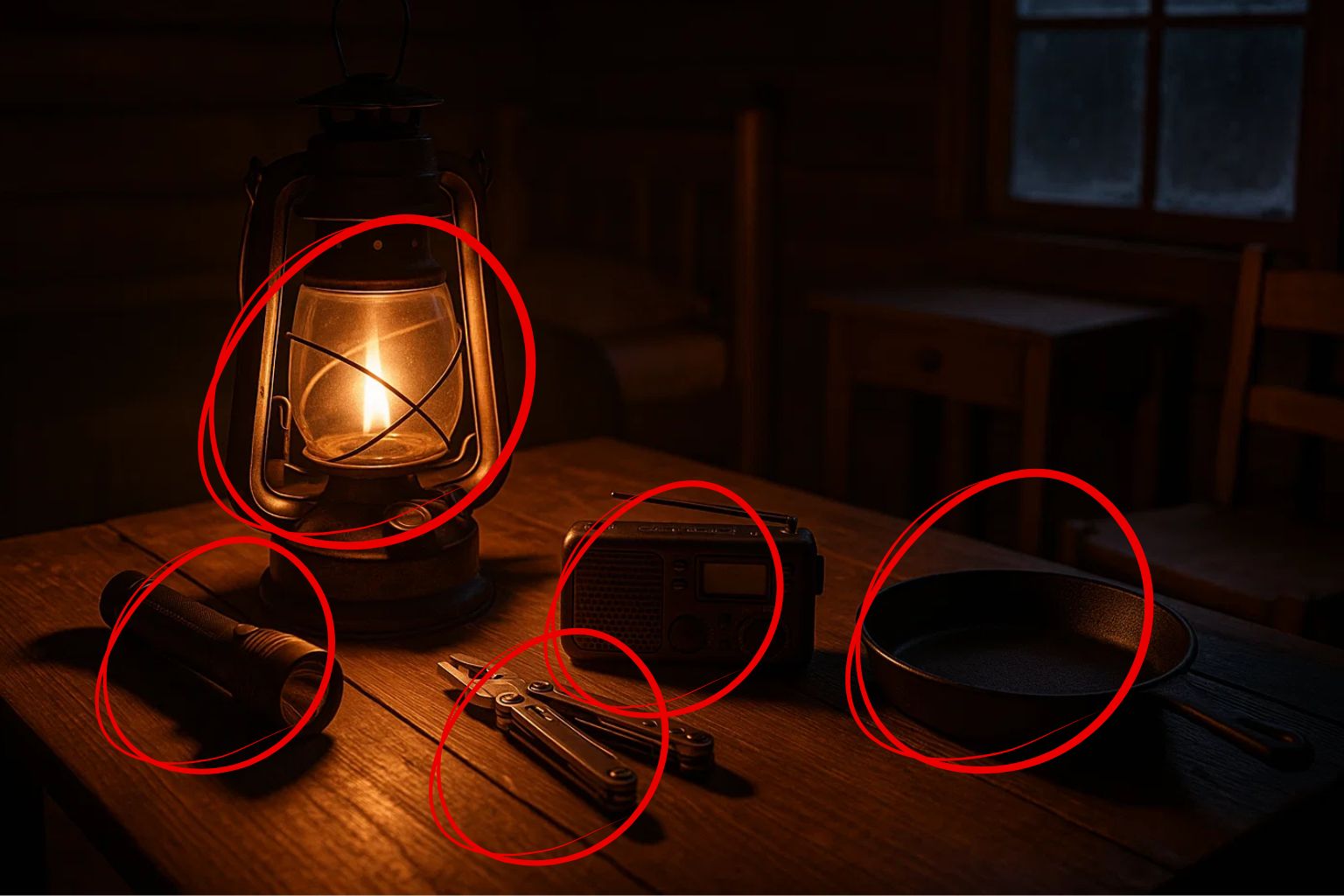
- The foundation, which every scenario requires: the ability to live without grid power for weeks to months. Water, food, sanitation, heat, and a way to cook and see in the dark, independent of the wall socket. This covers all three, and it’s where the majority of your effort belongs.
- The solar-storm-specific layer: understanding that the outage could run a year or more if transformers are lost, which pushes your food, water, and power thinking from “two weeks” toward “renewable and repeatable.”
- The EMP-specific layer: Faraday protection for a few genuinely critical electronics. Cheap, targeted, and the only place this investment makes sense.
- The cyber-specific layer: essentially none beyond the foundation, which is exactly why it’s the most dangerous one to ignore, because it’s the likeliest and it rewards only the preparation that’s least exciting to buy.
Where this leaves you
The mistake isn’t failing to prepare for grid-down. It’s preparing for the dramatic version, the nuclear EMP, the movie scenario, while neglecting the foundation that all three threats actually demand and that the two likeliest ones (solar and cyber) demand almost exclusively. Faraday bags feel like preparedness because they’re specific and tangible. But a stack of shielded electronics next to two weeks of water is a plan optimized for the least likely threat and helpless against the duration of the most likely ones.
The rational build is the reverse. Start from the shared consequence: extended time without the grid, possibly very extended. Solve water, food, sanitation, and power at that scale first, because that foundation carries you through all three scenarios regardless of which one arrives. The single most important shift is thinking past the two-week mark, because the transformer problem means a severe event isn’t a long camping trip, it’s a period where the modern supply of power simply isn’t coming back on any timeline you can wait out passively. What matters at that point isn’t how much you stored. It’s whether any part of your setup renews itself without the grid. A source of power you can regenerate, rather than a battery bank you’ll drain, is the line between preparing for a blackout and preparing for its aftermath.
Pick the threat model honestly. Then build for the consequence they share, not the one that makes the best story.
The Video Every Prepper’s Talking About: