In 1944, about 20 million American households were growing their own food.
Not on farms. In backyards, vacant lots, schoolyards, apartment rooftops and city parks. Those gardens produced roughly 8 million tons of food that year, the equivalent of more than 40 percent of all the fresh fruits and vegetables Americans ate.
Read that again, because it is one of the most remarkable facts in American history and almost nobody knows it. In the middle of the largest war the world has ever seen, close to half of the country’s fresh produce came from ordinary people with shovels, most of whom had never gardened before.
This is how it happened: the first war gardens of 1917, the tin shortage that made home growing a national necessity, what twenty million beginners actually planted, and why the whole thing vanished almost as fast as it appeared. Then the part that matters for you: how to plant a victory garden of your own, using the same crops and the same logic that worked eighty years ago.
It Started a War Earlier
The idea did not begin with World War II. It began with World War I.
In March 1917, a timber millionaire named Charles Lathrop Pack organized the National War Garden Commission. Europe’s farms had been turned into battlefields, millions of farm workers had become soldiers, and the United States was shipping enormous quantities of food overseas to feed its allies. Somebody had to make up the difference at home.
Pack’s answer was to turn every patch of unused ground into a food plot. The results were immediate. About 3 million new gardens were planted in 1917. By 1918, more than 5.2 million were under cultivation, and Americans put up roughly 1.45 million quarts of canned fruits and vegetables from them.
When the war ended, the campaign faded. Many people kept their gardens anyway. But the national effort dropped away, and for twenty years the idea mostly slept.
The Tin Shortage That Changed Everything
Then came December 1941, and a problem most Americans never connect with food.
Japan’s advance through Southeast Asia cut the United States off from the tin mines of Malaya, which supplied much of the tin the country used. Tin is what coats a food can. Without it, you cannot can food at industrial scale, and without cans you cannot ship food any real distance.
At the same time, the military needed enormous amounts of canned food to feed troops on two fronts, and the trucks, trains and ships that normally moved produce around the country were needed for the war.
The government’s response was rationing. Food rationing began in the spring of 1942, and as the war went on it spread across sugar, coffee, meat, fats, cheese and canned goods. Families received ration books with stamps, and every purchase of a rationed food cost points as well as money. Canned vegetables became expensive in the one currency that mattered: ration points.
Fresh vegetables you grew yourself cost no points at all.
That single fact did more to create the victory garden movement than any poster ever printed.
Twenty Million Beginners
In 1942, about 15 million families planted victory gardens. By 1944, the number had reached roughly 20 million.
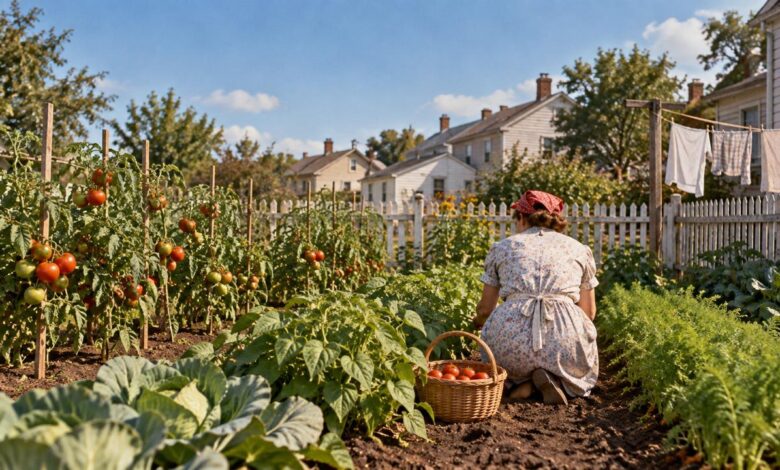
They grew food everywhere. Backyards and front lawns. Vacant city lots. Rooftops of apartment buildings. Strips of land beside railroad tracks. Public parks were divided into plots and handed out to residents who had no yard at all. In Boston, seven acres of land in the Fenway became the Fenway Victory Gardens, which are still being farmed today, one of only two original victory gardens in the country that never stopped.
Schoolchildren were recruited too. The U.S. School Garden Army enlisted kids as “soldiers of the soil”, giving them plots, instructions and a sense that their row of beans was part of the war effort. In a real way, it was.
The government flooded the country with help. The Department of Agriculture and others distributed several million pamphlets, posters and handbooks on what to plant, when to plant it, and how to can and dry the harvest. Seed companies, magazines, radio programs and newspapers all joined in. Gardening went from a hobby to something close to a civic duty.
Most of the people doing this had never grown anything. They learned from pamphlets, from neighbors, and from mistakes. And collectively, as beginners, they fed close to half the country’s fresh produce needs.
What They Actually Grew
The victory garden was not about variety or beauty. It was about calories, nutrition and reliability, and the crop list reflects that.
The most commonly recommended crops were:
- Beans, productive, easy, and high in protein
- Beets, with the bonus that the greens are edible too
- Cabbage, which stores well and can be made into sauerkraut
- Carrots, which keep for months in cool storage
- Kale, hardy and cold tolerant, producing for most of the season
- Lettuce, fast and easy for fresh eating
- Peas, early-season and productive
- Tomatoes, the most popular crop then and now, and ideal for canning
- Squash, heavy yields from a small number of plants
Notice what these have in common. Almost all are easy for a beginner, most produce heavily in a small space, and many either store well whole or preserve well by canning or drying. The list was built around the reality that the people growing it had little experience and limited room.
That is exactly why it still works.
The Canning Boom
A garden that produces more than a family can eat in summer is only half a food supply. The other half is putting it up for winter, and Americans canned on a scale that has never been repeated.
Kitchens across the country turned into small processing plants every late summer. Community canning centers opened where families could share equipment. The government’s how-to manuals covered canning, drying and storing, because a harvest that rotted in October did nothing for anyone in February.
This is the part of the victory garden story that modern gardeners most often skip, and it is the part that turned a hobby into a food supply. Growing tomatoes is pleasant. Having two hundred jars of tomatoes on a basement shelf in January is security.
The Part Nobody Talks About
Here is the detail that should change how you read this whole story.
When Eleanor Roosevelt planted a victory garden on the White House lawn, she did it over protests from the Department of Agriculture. Officials worried that a flood of amateur gardeners would waste seed, fertilizer and equipment that commercial farms needed more, and that the effort would hurt the agricultural industry.
The experts were wrong. The amateurs ended up supplying the equivalent of more than 40 percent of the nation’s fresh produce.
Sit with what that means. In the middle of a national emergency, with the commercial supply chain strained by war, a huge share of the fresh food Americans ate came not from the system but from millions of households acting on their own, on scattered plots no single failure could knock out. A tin shortage could cripple a canning plant. It could not touch a backyard tomato.
And then, almost as soon as the war ended, the gardens disappeared. Rationing wound down, with sugar the last to go in 1947. Grocery stores filled up again. Commercial agriculture boomed. Within a few years most victory gardens were back to lawn, and the knowledge of how to feed a household from its own ground skipped a generation.
That is the real lesson here, and it is not about history. The supply chain we depend on today is far more concentrated than the one in 1942, which is why a single cyberattack or plant fire can shake it now. The victory gardeners had something we mostly gave up: a backup that lived in their own yard.
Your Victory Garden Today
You do not need twenty acres, or even a yard. The victory garden was designed for beginners with limited space, and the same approach works now. But before you plant anything, it helps to know what a small garden can and cannot do, because the numbers surprise almost everyone.
What a 10 by 10 Garden Really Produces
A 10 by 10 foot bed fits roughly four 10-foot rows at normal spacing. Extension yield charts give a realistic picture of what each row can produce in a good season. From LSU AgCenter’s expected yield tables, scaled to a single 10-foot row:
- Tomatoes: about 25 pounds
- Potatoes: about 20 pounds
- Sweet potatoes: about 20 pounds
- Onions: about 22 pounds
- Carrots: about 15 pounds
- Winter squash: about 15 pounds
- Beets: about 10 pounds
- Lettuce: about 10 heads
- Peas: about 4 pounds
- Bush snap beans: about 3 pounds
Those are expected yields for a gardener doing things right. First-year gardeners often get less, and a bad summer can cut any of them in half.
A typical mixed beginner bed, say a row each of tomatoes, potatoes, winter squash and carrots, comes out around 75 pounds of food for the season. That is a real harvest. It is a lot of fresh eating, a shelf of canned tomatoes, and a box of squash in the basement.
It is also, measured in calories, about one week of food for one adult.
Calories Versus Vitamins
This is the part almost every gardening article skips, and it is the most important thing to understand if your goal is food security rather than fresh salads.
An adult needs roughly 2,000 calories a day, which is about 730,000 calories a year. Most garden vegetables are low in calories. A pound of tomatoes is around 80 calories. A pound of lettuce is under 70. You could eat a wheelbarrow of either and still be hungry.
A few crops are different. Potatoes run about 350 calories a pound, and sweet potatoes about 390. Plant the entire 10 by 10 bed in potatoes and a good season gives you roughly 80 pounds, about 28,000 calories. That is two weeks of food for one adult, from the most calorie-dense thing you can grow in that space.
So be honest about what a backyard garden is for. It is not where most of your calories come from. Calories come from stored staples like rice, beans, flour and fat. What the garden does better than anything in your pantry is supply the vitamins a stockpile is missing: vitamin C, vitamin A, folate, and fresh food that keeps people eating. A pantry of rice and beans plus a working garden is a diet. Either one alone is not.
If you want your garden to pull more weight on calories, give the space to potatoes, sweet potatoes, winter squash and dry beans, and grow the salad crops around the edges.
When to Plant
Everything starts with one date: your average last spring frost. Your local extension office publishes it, and it decides almost the whole calendar.
Cool-season crops go in two to four weeks before that date, as soon as the soil can be worked. Peas, potatoes, lettuce, kale, carrots, beets and onions all tolerate cold and do better planted early.
Warm-season crops go in after the danger of frost has passed and the soil has warmed. Tomatoes, beans, squash and sweet potatoes will sulk or die if you rush them into cold ground.
Fall crops go in again in mid to late summer. Kale, carrots, beets and lettuce planted then mature in the cooler weather of autumn, and kale in particular will keep producing after the first frosts.
Succession Planting
The victory gardeners knew a trick that roughly doubles what a small bed produces: never leave ground empty.
Instead of planting all your lettuce at once and drowning in it for two weeks, sow a short row every two to three weeks so it keeps coming. When the spring peas finish in early summer, pull them and plant bush beans in the same spot. When the summer crops come out, put in a fall row of kale or carrots.
A bed that grows peas, then beans, then kale in a single season does the work of three beds. For anyone gardening in a small space, this matters more than any other technique.
What to Preserve, and How
Not everything should be canned, and some things should not be canned at home at all without the right equipment.
Store whole, no processing: potatoes, sweet potatoes, winter squash, onions and carrots. Cure them, then keep them somewhere cool and dark. This is the easiest preservation there is and it costs nothing.
Can in a water bath: tomatoes, with added acid, using a tested recipe. Tomatoes sit right on the edge of safe acidity, which is why tested recipes call for lemon juice or citric acid.
Pressure can only: green beans and other low-acid vegetables. These can carry botulism if water-bath canned. If you do not own a pressure canner, freeze or dry them instead.
Dry: beans left on the plant until the pods rattle, then shelled and stored. Dry beans keep for years and are the protein crop of a food security garden.
Freeze or dehydrate: kale and other greens, peas, and anything you cannot can safely.
What Not to Plant
If the goal is food security, some popular crops are not worth the space.
Too much lettuce and salad greens. Grow some, but they are low in calories and they do not store. A whole bed of them feeds you for a month, then nothing.
Too much zucchini. One or two plants is plenty. Every gardener who planted six has spent August leaving bags of it on neighbors’ porches, and it does not keep.

Sweet corn in a small bed. It needs a large block of plants to pollinate well, takes up a lot of space for each ear, and does not store. If you have room for corn, grow a flint or dent variety meant for drying and grinding.
Fussy crops. Cauliflower, celery and melons punish beginners. Save them for the second or third year.
Hybrid seed, if you want independence. It grows fine, but seed saved from hybrids does not reliably come back true. Choose open-pollinated varieties for anything you plan to save seed from.
Plant One This Season
Pick one spot that gets six or more hours of sun.
Choose three crops from the victory garden list. Beans, tomatoes and squash are the classic beginner trio.
Then plant them, and keep a notebook of what works. Twenty million people who had never gardened before learned this from pamphlets in a single season. You have more information at your fingertips than any of them ever did.
The most important thing a victory gardener had was not land, or skill, or seed. It was the decision to start.