How to Tune and Use an Emergency Radio (Even If You’ve Never Touched One Before)

When severe weather approaches or evacuation orders begin circulating, communication does not collapse instantly. It degrades in layers. Notifications arrive late. Maps stall mid-refresh. Calls connect, then drop. Social feeds recycle fragments.
You still have signal.
You just don’t have clarity.

If you don’t know how to tune and use an emergency radio, you’re dependent on a layered system designed for efficiency, not overload.
Emergency communication prioritizes broadcast channels before individualized data streams. That means AM, FM, and NOAA weather bands often carry complete instructions while smartphones stall inside congested networks.
Systems don’t fail loudly. They thin out.
If you’ve never touched an emergency radio before, the risk is not ownership. It’s operational delay when clarity narrows.
Why Broadcast Radio Outlasts Cellular Networks
Cellular systems rely on multiple synchronized components:
- Towers
- Fiber backhaul
- Switching centers
- Authentication servers
- Grid power or generator reserves
Each layer must function simultaneously.
Video: Top 5 Books for Preppers in 2026 (Discounts + Bonus Bundles)
Broadcast radio works differently. A transmitter sends one signal outward. Thousands of receivers capture it passively. No handshake. No routing queue. No per-device bandwidth allocation.
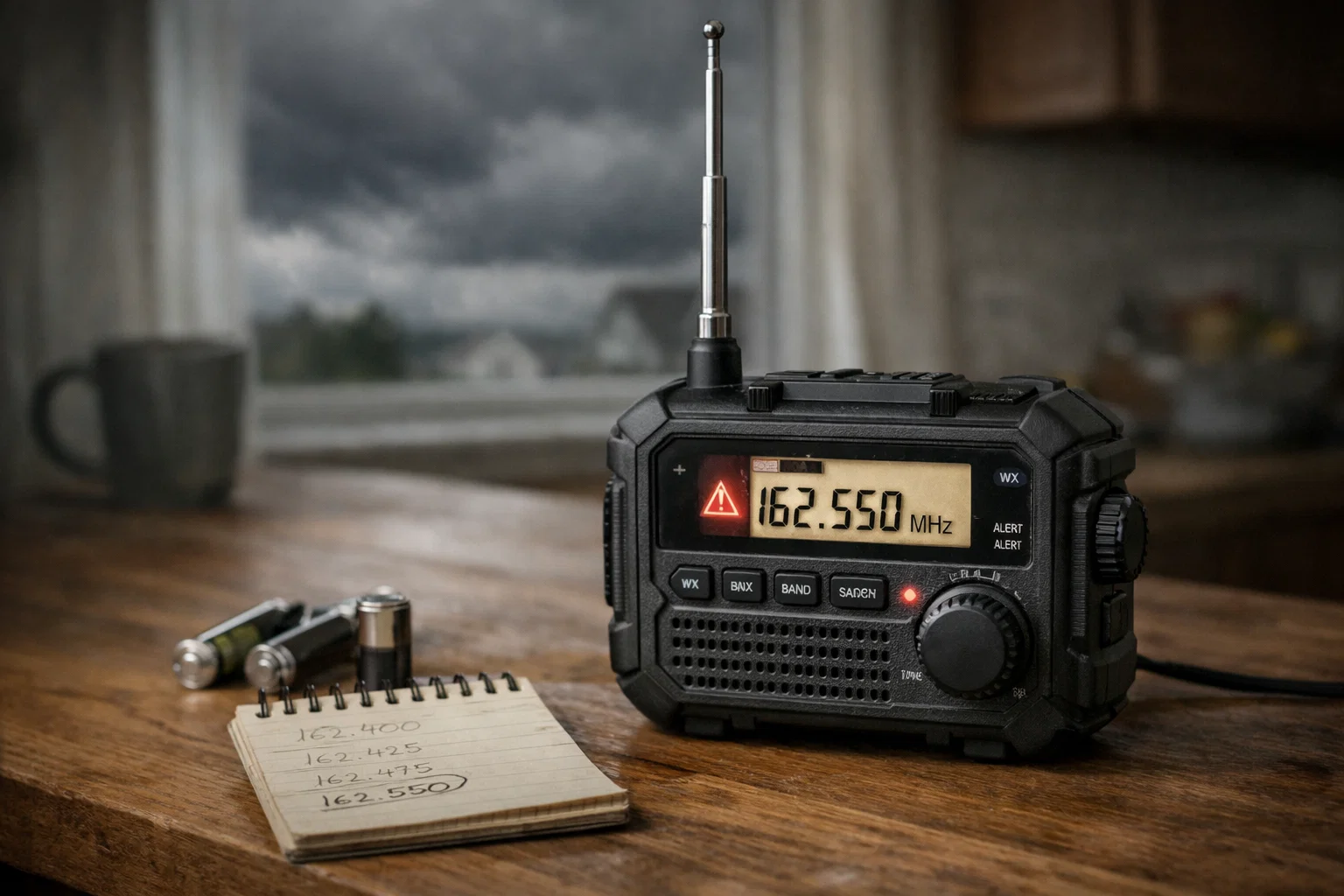
That structural simplicity is why the National Oceanic and Atmospheric Administration maintains NOAA Weather Radio transmitters nationwide. These operate on VHF frequencies between 162.400–162.550 MHz and are engineered specifically for hazard alerts.
You do not request NOAA data.
You receive it continuously.
During disasters in states like Florida, California, and Texas, cellular congestion has repeatedly preceded full outage. Towers remain powered but saturated. Data throttles. SMS queues form. Calls fail intermittently.
Meanwhile, broadcast transmitters continue pushing alerts.
Help narrows before it disappears.
Preparedness isn’t fear. It’s math.
The Three Bands That Carry Critical Information
Understanding what each band does prevents wasted minutes during urgency.
AM
- Long-distance coverage
- State-level transportation and emergency updates
- Multi-county reach
High-power AM stations often act as regional backbones during crises.
FM
- Clearer audio
- Localized updates
- Community shelter announcements
FM is effective but range-limited.
NOAA Weather Band
- Seven dedicated hazard frequencies
- Continuous looped weather data
- Automated emergency alerts
The National Weather Service injects warnings directly into NOAA transmitters. This bypasses cellular prioritization entirely.
Visit the store page to grab the best deals!
If you do not know your specific NOAA frequency, tuning becomes guesswork under pressure.
The Seven NOAA Frequencies, And How to Select the Right One
NOAA operates on:
162.400 MHz
162.425 MHz
162.450 MHz
162.475 MHz
162.500 MHz
162.525 MHz
162.550 MHz
Each transmitter uses only one.
Signal strength depends on:
- Distance to transmitter
- Elevation and terrain
- Urban density
- Building materials
Auto-scan can lock onto a weaker distant station if it transmits more frequently.
Identify your nearest transmitter in advance.
Test reception indoors and outdoors.
Store the clearest signal in memory.
Under stress, scanning blindly wastes minutes.
Minutes compound.
SAME Codes, Precision Inside the Noise
NOAA Weather Radio uses SAME (Specific Area Message Encoding) to digitally tag alerts.
Each message contains:
- A 6-digit geographic FIPS code
- Event classification
- Duration
- Originating office
Format: PSSCCC
P – subdivision
SS – state
CCC – county
When your radio is programmed with your county’s SAME code, it remains silent unless a matching alert is transmitted.
Without SAME programming:
- Every alert in range triggers
- Alert fatigue builds
- Important warnings blend with irrelevant ones
With SAME:
- Activation becomes selective
- Nighttime alerts cut through silence
That is precision filtering under stress.
You’re not abandoned. You’re deprioritized.
Why AM Travels Farther at Night
After sunset, the ionosphere becomes more reflective to medium-frequency signals. AM waves bounce off this atmospheric layer and return toward earth instead of dissipating.
This allows high-power AM stations to travel hundreds of miles beyond daytime range.
FM remains largely line-of-sight. Terrain and distance limit it quickly.

During infrastructure strain, this difference becomes operational.
A distant AM station may reach you after dark even if local stations lose power.
Your reception radius expands when visibility drops.
Range increases as infrastructure strains.
How Emergency Alerts Cascade Across Broadcast Networks
Emergency messages propagate through the Emergency Alert System (EAS).
Sequence:
A local office issues a warning.
The message is digitally encoded.
Primary entry stations receive it.
They rebroadcast automatically.
Other stations monitoring them relay it further.
This cascading structure ensures propagation even if individual stations fail.
Large regional AM stations often serve as backbone nodes because they operate at high power and maintain generator redundancy.
The system is designed for reach, not personalization.
That explains why radio alerts often precede mobile confirmation.
Institutional Triage Under Stress
Emergency communication follows prioritization logic.
Urban population centers receive granular updates.
Outlying areas receive summarized bulletins.
Broadcast staffing consolidates during prolonged events.
Overnight staffing thins before infrastructure collapses.
Information cycles repeat at scheduled intervals rather than continuous updates.
If you tune in mid-cycle, you may wait minutes before hearing a full briefing.
Delay compounds.
Power Is the First Constraint
An emergency radio without layered power becomes inert.
Look for:
- Replaceable batteries
- Rechargeable internal pack
- Hand-crank generator
- Solar charging capability
During prolonged outages, battery resupply becomes a bottleneck before grid restoration. Retail shelves empty within hours. Delivery logistics stall.
If your radio relies on one source, your listening window narrows.
Layering extends continuity.
Indoor Reception Fails Quietly
Concrete, metal siding, basements, and high-rise density weaken VHF signals.
Weak reception often gets mistaken for transmitter failure.
Corrective actions:
- Move near a window
- Elevate the device
- Adjust antenna vertically
- Step outside briefly
Signal degradation inside structures occurs before broadcast failure.
Systems thin out before they collapse.
What Happens When You Wait
You hear about evacuation after the first wave leaves.
Fuel lines have already formed.
Highways are partially congested.
Shelter intake begins limiting capacity.
Information delay converts into mobility delay.
If your alert arrives second, your options shrink first.
Preparedness tools are not dramatic purchases. They are redundancy layers against timing loss.
The Narrowing Margin
Communication rarely vanishes instantly. It fragments.
Data slows.
Alerts stagger.
Specifics fade into summaries.
An emergency radio reconnects you to a broadcast layer engineered for strain.
That connection preserves clarity when layered systems thin.
If you have never tuned, programmed, and tested yours, competence can be built in minutes.
Waiting builds dependence.
When the signal narrows, only those already listening hear the full instruction set.
The Video Every Prepper’s Talking About: