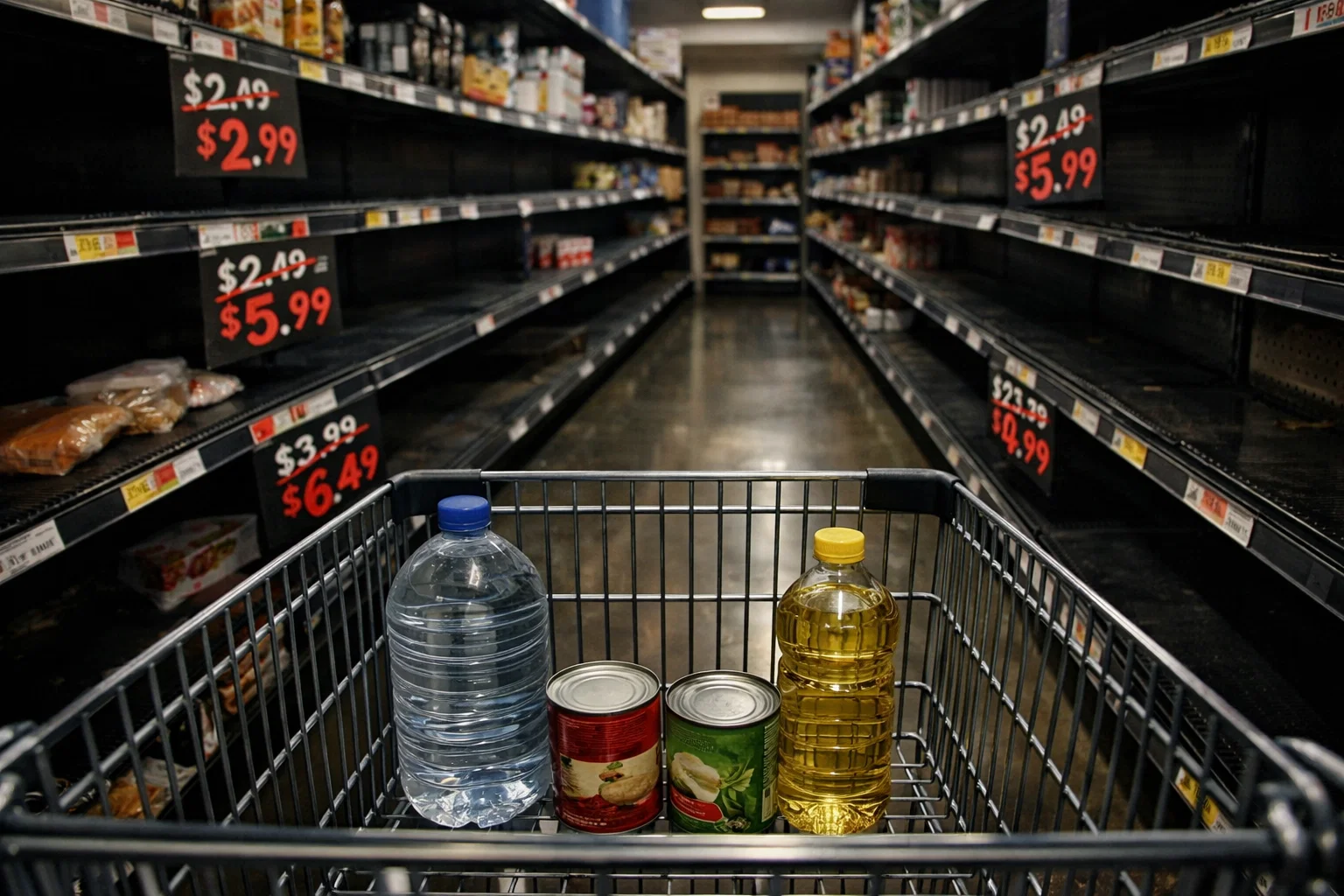
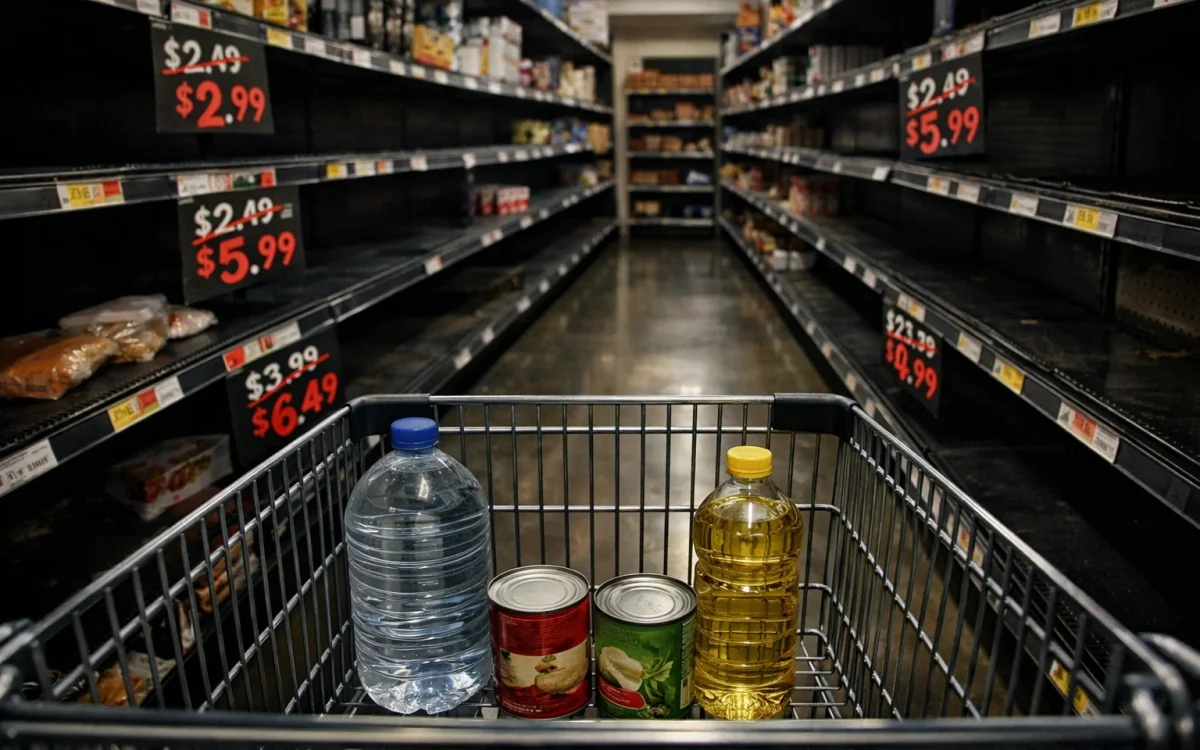
Prices in the U.S. don’t rise slowly, they stay quiet until the system can’t absorb pressure anymore. Most people assume they’ll notice when things start getting expensive and adjust in time. But prices are not an early warning. They are the final stage of a process that has already been unfolding in the background. Retail runs on thin inventory, often just a few days of supply, and supply chains are built for efficiency, not stress. When pressure builds, it doesn’t show up in price first. It shows up in smaller deliveries, slower restocks, and fewer options on shelves.
That creates a gap between perception and reality. Prices still look stable, so nothing feels urgent. But underneath, supply is already tightening. Distributors start cutting volume, prioritizing certain regions, and delaying shipments. Stores stretch what they have, missing brands, partial shelves, inconsistent availability, while prices remain just stable enough to avoid triggering a reaction. What looks normal is actually the system delaying the impact.

Then the shift happens all at once. Supply turns into scarcity, scarcity triggers demand, and demand forces prices to jump, often within a single restock cycle. Not gradual increases, but sudden resets. By the time prices clearly rise, the window to act has already closed. Options are limited, availability is unstable, and you’re no longer choosing, you’re reacting.
The 10 Items That Always Spike First
This isn’t a guess and it’s not based on opinion. These are the same categories that move first every time a system comes under pressure, pandemics, supply chain shocks, fuel disruptions, inflation cycles. Different trigger, same pattern. These items tighten early, disappear quietly, then come back at a higher price once demand concentrates. That sequence is already visible in parts of the U.S. right now. What follows isn’t a list of “useful things”, it’s a list of what consistently moves before people realize they needed it.
Shelf-Stable Food Disappears Before It Gets Expensive
In the U.S., grocery stores don’t stock weeks of food, they stock 3 to 5 days of inventory on average for fast-moving items like rice, pasta, and canned goods. That means it doesn’t take panic to create shortages. A 10–15% increase in buying, people grabbing a few extra items, is enough to clear shelves within 48–72 hours. And this pressure isn’t isolated. Rising transport costs and agricultural inputs, like fertilizers already up 30–40% in recent cycles, are tightening supply before it even reaches the store.
Prices don’t react first, availability does. When demand spikes, suppliers can’t instantly increase output, and deliveries don’t match the surge. Stores start receiving partial shipments, often 20–40% below normal volume, and that creates visible gaps. But prices stay temporarily stable because retailers are still selling older inventory at previous costs. What you’re seeing is a system running on what’s left, not what’s coming.
Video: Top 5 Books for Preppers in 2026 (Discounts + Bonus Bundles)
Then the reset happens. When new inventory arrives, it reflects higher wholesale costs, fuel, transport, sourcing, which have already increased in the background. That’s when prices jump, often 15–30% in a single restock cycle. And by then, control is already gone. You’re not buying early, you’re competing for limited supply, with fewer options and higher prices at the same time.
Cooking Oil Is Already Rising, And It Won’t Reverse Quickly
Cooking oil is already in a confirmed upward cycle, and the numbers are not small. Over the past 12–18 months, olive oil prices have surged 40% to over 100% globally, driven by droughts and failed harvests in major producing regions. In the U.S., that’s already translated into 30–70% higher retail prices, while basic vegetable oils have shown 20–40% volatility. This isn’t demand pressure, it’s reduced production at the source. And that production is now being hit from another direction: fertilizer and agricultural costs have already increased 30–40%, raising the baseline cost of growing and processing food.
What makes this different is that it doesn’t reverse quickly. Oil production depends on harvest cycles, and those cycles are already compromised. A bad season raises prices. Consecutive bad seasons lock them in. Olive trees don’t recover in months, they take years. That creates a pattern: gradual increase → sudden jump → new baseline. And once that baseline resets, it rarely drops back. What you’re seeing now isn’t a temporary spike, it’s a structural shift that keeps pushing food costs higher across the system.
Water Becomes a Problem the Moment Distribution Slows
The issue with water isn’t total supply, it’s distribution speed. The U.S. has water, but stores don’t hold large reserves of bottled water. Most locations carry 1–3 days of inventory, relying on constant deliveries. When distribution slows, even slightly, local shortages appear almost immediately. During past disruptions, a 20% spike in demand or delayed shipments was enough to clear shelves within 24–48 hours in affected areas.

That’s where the system shows its weakness. People assume water will always be available because it’s essential, but availability depends on logistics, not abundance. When trucks are delayed or rerouted, stores don’t get restocked on time, and demand concentrates fast. Prices may rise later, but the first impact is access, empty shelves, purchase limits, and inconsistent supply. At that point, trust in the most basic system, access to water, starts to weaken, because it becomes clear how quickly it can be disrupted.
Medications Don’t Spike, They Vanish Without Warning
Medications don’t behave like normal retail items. In the U.S., both OTC drugs and prescriptions run on tight supply chains with limited buffer stock. Pharmacies often hold 1–2 weeks of inventory for common medications, sometimes less for specific prescriptions. When demand increases or shipments are delayed, the system doesn’t raise prices first, it runs out. That’s why shortages don’t show up as gradual increases. They show up as “out of stock” with no clear restock date.
The fragility comes from dependency. Roughly 70–80% of active pharmaceutical ingredients (APIs) used in the U.S. are manufactured overseas, primarily in China and India. When production slows, exports tighten, or logistics are disrupted, the impact isn’t immediate at the consumer level, but it builds quietly. Then pharmacies start receiving partial orders, substitutions increase, and certain medications simply stop arriving. There’s no visible warning until access is already limited.
That’s where the real break happens. You can adapt to higher food prices or limited options, but medication shortages remove flexibility. If a prescription isn’t available, there is no easy substitute, no delay without consequence. The system doesn’t prioritize individual continuity it allocates based on availability. And when that availability tightens, the shift isn’t financial,it’s personal. It exposes how dependent your health is on a supply chain you don’t control.
Fuel Is the Trigger That Pushes Everything Higher
Fuel doesn’t just affect what you pay at the pump, it controls the cost of moving everything else. In the U.S., nearly 70% of goods are transported by truck, and fuel is one of the largest operating costs in that system. When oil rises, the effect is immediate. Crude has already pushed past $100 per barrel in recent spikes, and gasoline has moved from around $3 to over $4 per gallon in short cycles. At the same time, critical choke points like the Strait of Hormuz, where roughly 20% of global oil flows, are under pressure, and shipping costs have surged as a result.
The impact doesn’t stay contained. When fuel increases, transport costs rise, production costs rise, and delivery slows at the same time. During past spikes, diesel has jumped 30–50% within months, and that pressure propagates across the system almost immediately. Food becomes more expensive to produce and move. Water becomes harder to distribute. Every supply chain that depends on constant movement starts tightening at once.
That’s when the problem stops being about individual items. You’re no longer dealing with isolated price increases, you’re dealing with a system-wide shift. When fuel moves, everything moves with it. And once that pressure starts spreading, the cost of access itself becomes unstable.
Batteries Stay Cheap Until Demand Concentrates Overnight
Batteries don’t rise slowly, they sit at normal prices until demand hits all at once. In the U.S., retailers carry limited backstock, often only a few days’ supply for fast-moving sizes like AA and AAA. During outages or storm warnings, demand can jump 2–3x in a single day, and shelves clear within hours. The price doesn’t change first, the availability does.
By the time stores restock, the situation has already shifted. Suppliers are dealing with higher demand and tighter distribution, and new inventory often comes in at 10–25% higher cost, sometimes with purchase limits still in place. What looked like a cheap, low-priority item turns into something scarce overnight, and once demand concentrates, you’re not buying early anymore, you’re competing for what’s left.
Hygiene Supplies Follow Panic, Not Supply Logic
Hygiene products don’t spike because supply collapses first, they spike because behavior changes fast. In the U.S., items like toilet paper, wipes, soap, and sanitizers are stocked for predictable demand, not surges. When uncertainty hits, buying doesn’t increase gradually, it jumps. During past events, demand surged 3–5x within days, emptying shelves even when production capacity hadn’t changed.
That’s what breaks the system logic. Supply may still exist upstream, but it can’t be distributed fast enough to match sudden demand concentration. Stores impose limits, restocks lag, and products disappear in waves. Prices may adjust later, but the first impact is irrational scarcity, caused not by lack of production, but by how quickly normal behavior collapses under pressure.
Ammo Prices Move Before Anything Actually Breaks
Ammo doesn’t wait for disruption, it reacts to the expectation of it. In the U.S., demand spikes are driven by perception: elections, policy talk, social tension. Buying surges early, often doubling or tripling demand within weeks, long before any actual shortage exists. Retail shelves thin out quickly, and online inventories tighten even faster. Prices follow, with common calibers historically jumping 50–200% during peak demand cycles.

That’s what makes it an early indicator. Ammo doesn’t respond to broken systems, it responds to the belief that systems might break. By the time most people notice rising prices, the shift has already happened. Supply hasn’t collapsed, but access has tightened, and the market has already moved ahead of reality. It exposes the gap between anticipation and reaction, and how early movers lock in availability while everyone else pays more for less.
Coffee Is the Everyday Item That Reveals Inflation First
Coffee is one of the fastest ways inflation becomes visible because it’s bought constantly and noticed immediately. In the U.S., retail coffee prices have already increased 15–30% over the past 1–2 years, with spikes driven by droughts in Brazil and supply disruptions in key growing regions. Wholesale prices have been even more volatile, at times jumping 40–80%, and those costs move downstream into grocery shelves and cafés with a delay. Unlike bulk goods, coffee isn’t something people buy once and forget, it’s part of a daily routine, so every increase gets noticed.
That’s what makes it a signal. When something you buy every week keeps getting more expensive, it’s not an isolated issue, it reflects pressure already moving through the system. Coffee doesn’t drive inflation, it exposes it. And by the time it becomes “noticeably expensive,” the underlying costs, fuel, transport, production, have already been rising across multiple sectors. It’s the everyday item that makes a larger shift impossible to ignore.
By the Time Prices Double, Your Options Are Already Gone
Every category follows the same sequence, and it’s already visible if you look at how these items behave under pressure. It doesn’t start with higher prices, it starts with availability. The product is still there, but in smaller quantities. Then inconsistency sets in. One week it’s stocked, the next it’s missing. Brands rotate, substitutes appear, and restocks don’t match what was sold.
Then comes absence. Certain items stop showing up entirely, or only return in limited amounts. This is the phase most people misread, because prices may still look manageable. But what’s actually happening is supply falling behind demand. The system is no longer meeting normal consumption patterns, it’s rationing without saying it directly.
After that, the price spike hits. And when it does, it’s not a gradual increase, it’s a reset. 15%, 30%, sometimes 50% jumps in a single restock cycle, depending on the category. But by this point, the price is no longer the main problem. The real issue is that options have already narrowed. You’re paying more for fewer choices, and in some cases, just for the chance to get anything at all.
That’s where the shift becomes unavoidable. You’re no longer deciding what you want, you’re adapting to what’s left. And once the system reaches that stage, waiting stops being a strategy. Because the moment prices double isn’t when the problem starts, it’s when access has already been reduced.
Why Most People Miss the Window Every Time
Most people don’t act when supply tightens, they act when prices confirm it. That delay is consistent across every disruption. As long as shelves still look “good enough” and prices haven’t clearly jumped, the situation doesn’t feel urgent. So they wait for confirmation. But confirmation only comes after the system has already shifted.
Normalcy bias reinforces that delay. People assume the system will correct itself because it usually does. Temporary shortages feel like exceptions, not signals. Even when items become inconsistent or harder to find, it’s easy to rationalize it as a one-off issue. That mindset keeps people passive while availability is already changing in the background.
Visit the store page to grab the best deals!
And by the time prices finally move, 15%, 30%, sometimes more, the reaction kicks in. But at that point, it’s no longer early. Supply has tightened, demand has concentrated, and options have already narrowed. The pattern repeats because the trigger for action is wrong. People react to price, not supply. And price is always late.
What Happens After the Second Wave Hits
The first wave clears the obvious items. The second wave removes the backups. Once primary products thin out, demand shifts to substitutes, different brands, different sizes, lower-quality alternatives. That surge wipes those out next. What looked like “options” turns into a single choice, then none. This is where shortages spread sideways across categories, not just deeper within one.
At the same time, delayed shortages start showing up. Items that seemed unaffected begin to tighten because upstream supply has already been redirected or reduced. Deliveries arrive smaller, lead times stretch, and restocks become inconsistent across regions. Prices on these second-tier items then jump 20–40% as replacement costs catch up and retailers stop absorbing the difference.
There’s no snap-back after this phase. The system doesn’t return to the old baseline, it establishes a new one. Prices stabilize higher, availability remains uneven, and variety doesn’t fully recover. What was once normal becomes unavailable or permanently more expensive, and the gap doesn’t close, it becomes the new standard.
The Shift: Price Awareness Won’t Protect You, Timing Will
Watching prices feels like control, but it’s the wrong signal. Prices move after the system has already adjusted, after supply has tightened, after options have narrowed, after access has already started to slip. By the time something looks “expensive,” it’s not early anymore. It’s late. The real signal isn’t price, it’s availability. Slower restocks, missing items, fewer choices. That’s where the shift actually begins.
This is where the mindset has to change. If you’re reacting to price, you’re reacting to the past. If you’re watching availability, you’re seeing the system in real time. And once you recognize that pattern, the dependency becomes clear. Access isn’t guaranteed, it’s conditional. And when that condition changes, the only thing that separates early from late isn’t awareness. It’s timing.
The Video Every Prepper’s Talking About: