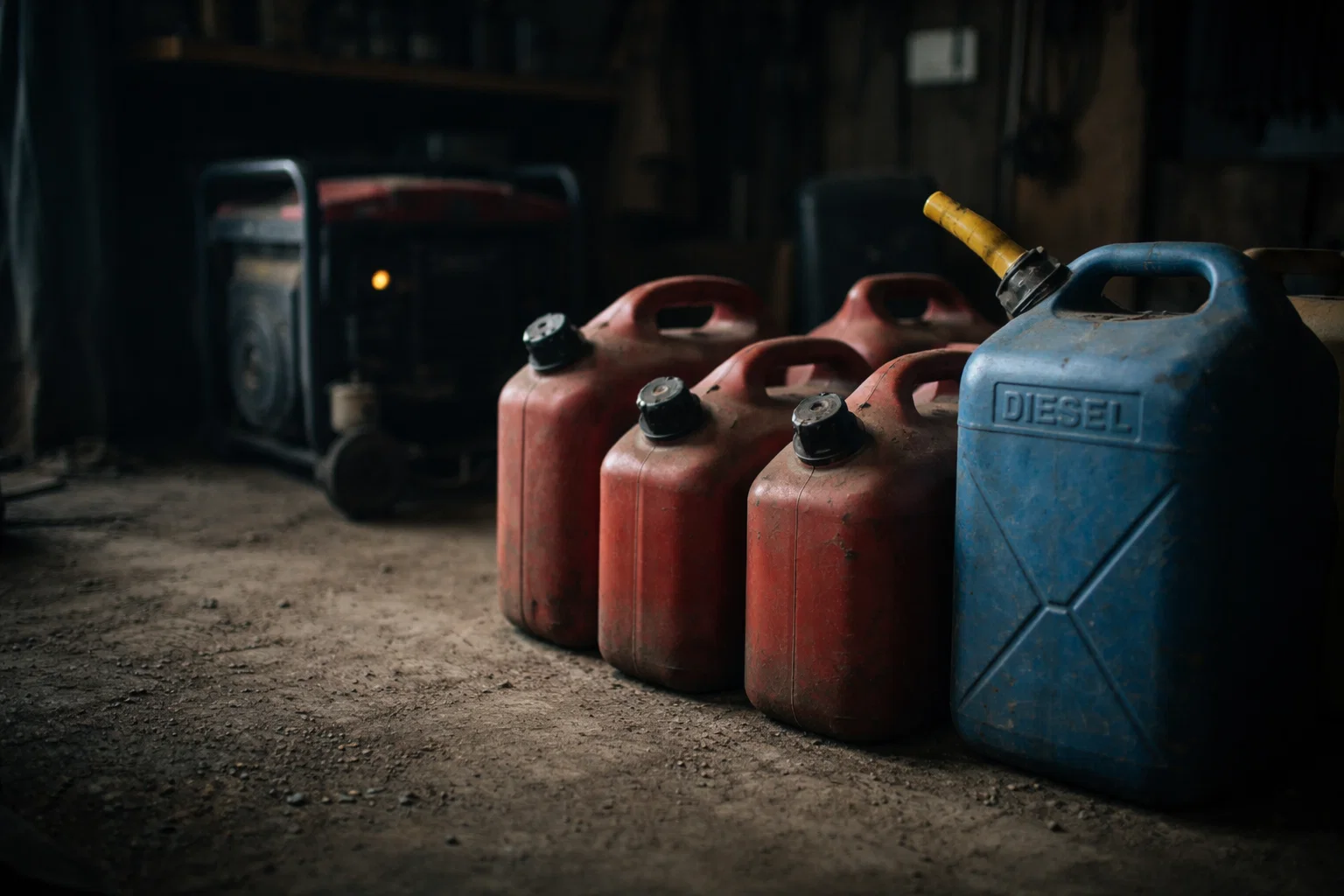
Gasoline and diesel are commonly stored for emergencies, generators, and critical equipment. Most people assume that if it’s sealed and sitting quietly, it’s still usable.
That assumption is the problem.

Time changes stored fuel in ways you can’t see. The breakdown doesn’t show up on a shelf. It shows up when an engine is supposed to start and doesn’t.
Shelf life matters because stored fuel only has value if it performs on demand. When it fails, there’s no correction window and no outside help.
Why Fuel Storage Shelf Life Matters
Fuel isn’t a static supply you stack and forget about. It’s a functional resource. If it doesn’t perform when you need it, it might as well not exist.
Power, transportation, and basic tools all depend on fuel quality, not just fuel quantity. A generator with bad fuel is dead weight. A vehicle with degraded fuel isn’t mobility. It’s a liability sitting in your driveway.
When fuel fails, capability disappears immediately. There’s no gradual decline you can work around. Lights don’t come on. Engines don’t catch. Tools don’t run. And at that point, you’re not dealing with an inconvenience. You’re dealing with a hard stop.
Fuel Degradation Is Gradual, Not Instant
Fuel doesn’t spoil. It breaks down.
That breakdown happens over time and is shaped by three variables: how long the fuel sits, the environment it’s stored in, and the type of fuel itself. Change any one of those, and the outcome changes.
Gasoline is the most common fuel people store, and it’s also the least forgiving. That’s why it’s the first place this problem shows up.
What Happens to Gasoline After Months of Storage
Gasoline is unstable by nature. It’s engineered to burn fast, not to sit quietly for long periods of time. Once it’s stored, the clock starts, whether you acknowledge it or not.
Time changes gasoline at a chemical level. Not all at once. Not dramatically. But enough to matter when you finally depend on it.
Oxidation and Chemical Breakdown
Gasoline reacts with oxygen. That reaction never stops. Every bit of air trapped in the container, every small exchange through plastic, feeds the process.
As oxidation progresses, gasoline begins to form gums and varnish. These are sticky residues created when fuel molecules break down and recombine into heavier compounds. You don’t see them floating around. They stay dissolved until heat and flow expose them.
This is where engines pay the price.
Gums and varnish coat fuel lines, clog filters, and restrict injectors. In carbureted engines, they stick needles, foul jets, and choke off fuel delivery entirely. The engine doesn’t fail violently. It cranks, sputters, or refuses to catch, leaving you guessing while time runs out.
This is why gasoline storage shelf life is shorter than most people expect. The fuel may still burn, but it no longer burns clean. And engines are far less forgiving than people assume.
Once residue forms, dilution doesn’t fix it. Shaking the container doesn’t fix it. Pouring it anyway just moves the problem downstream, straight into the equipment you’re counting on.
Volatility Loss Over Time
Gasoline is a blend of different components, and the lightest ones matter most. They’re what help fuel vaporize and ignite easily. Over time, those components evaporate, especially if the container isn’t perfectly sealed or is stored in heat.
When that happens, starting an engine becomes harder. Cold starts take longer. Combustion becomes incomplete. The engine may crank, stumble, or run rough before giving up entirely.
The fuel still looks usable. Same color. Same level in the can. But its behavior has changed. Volatility loss doesn’t announce itself. It shows up as weak performance at the exact moment you need reliable power.
That’s why people blame batteries, spark plugs, or carburetors first. The fuel is the last thing they suspect, and by the time they do, damage is already in motion.
Ethanol Blends and Moisture Absorption
Modern gasoline usually contains ethanol, and ethanol brings a separate set of problems. It attracts water. Actively.
Ethanol is hygroscopic, meaning it pulls moisture from the air even when the container appears closed. Over time, that water builds up inside the fuel.

Once moisture reaches a certain point, phase separation can occur. The ethanol and water drop out of suspension and settle, leaving a fuel layer above and a corrosive water-ethanol layer below. That bottom layer is what gets drawn into engines first.
This is one of the main reasons modern gasoline degrades faster than older formulations. You’re not just fighting oxidation and evaporation anymore. You’re fighting moisture intrusion and chemical instability that didn’t exist to the same degree in the past.
If you’re storing gasoline long term, especially fuel with ethanol, you’re dealing with a fuel that’s working against you from day one.
Why Small Engines Are Affected First
Small engines fail first because they’re the least tolerant systems you own. There’s no margin built in.
Carbureted engines rely on tiny jets and narrow passages to meter fuel. It doesn’t take much residue to disrupt that flow. A thin layer of varnish is enough to change fuel delivery. A small amount of gum can block it completely. Fuel injection systems are cleaner and more precise, but even they aren’t immune once degraded fuel starts circulating.
This is why generators, chainsaws, pressure washers, and lawn equipment are usually the first things that won’t start. They sit longer. They run less often. And they’re almost always carbureted.
When bad fuel hits a small engine, it doesn’t fail gracefully. It cranks without catching. It surges and dies. Or it refuses to respond at all. At that point, you’re not troubleshooting, you’re tearing down a fuel system with limited time and tools.
If your emergency plan depends on small engines, fuel quality isn’t optional. It’s the deciding factor between equipment that works and equipment that just takes up space.
What Happens to Diesel Fuel in Storage
Diesel is often treated as the safer long-term option, and in some ways it is. It doesn’t evaporate the way gasoline does, and it’s less volatile. That creates a false sense of security.
Diesel doesn’t usually fail by breaking down. It fails by getting contaminated.
Water Contamination and Condensation
Diesel storage problems usually start with water. Not a lot. Just enough.
Temperature cycling causes tanks to breathe. Warm air expands out. Cool air gets pulled in. That incoming air carries moisture, which condenses inside the tank over time. Steel, plastic, it doesn’t matter. If the fuel sits, water finds its way in.
Once water is present, diesel quality drops fast. Corrosion begins. Lubrication suffers. And you’ve created the perfect conditions for the next problem.
Microbial Growth (“Diesel Bug”)
Microbes live at the fuel-water interface. That thin boundary layer is all they need.
Bacteria and fungi feed on diesel and multiply quietly. As they grow, they produce sludge and acidic byproducts that don’t stay put. They get pulled into filters, lines, and injectors.
This is why diesel systems often fail suddenly. Filters clog without warning. Injectors foul. Engines starve for fuel even though the tank is full. If you’ve ever replaced a filter only to have it plug again days later, this is usually why.
Biodiesel Blends and Stability
Biodiesel blends make this problem worse. They hold water more readily and degrade faster than pure petroleum diesel.
That increased sensitivity means biodiesel-blended fuel depends heavily on additives and monitoring. Without them, storage life shortens significantly.
Diesel may last longer than gasoline, but it isn’t maintenance-free. Ignore it long enough, and it will fail just as hard, usually when you’re counting on it the most.
Realistic Fuel Storage Timeframes
There’s a lot of bad advice floating around about how long fuel “lasts.” Most of it assumes perfect conditions that almost no one actually has.
Gasoline has the shortest shelf life. Under normal storage conditions, untreated gasoline starts losing reliability within months. With stabilizer and good storage practices, you can extend that window, but it’s still limited. Gasoline is a rotating supply, not a long-term asset.
Diesel generally lasts longer, but only if it’s kept clean and dry. In real-world storage, water intrusion and microbial growth shorten its usable life faster than most people expect. Diesel buys you time, not immunity.

Propane is different. It doesn’t degrade and doesn’t oxidize. As long as the container remains intact, propane stays usable indefinitely. That’s why it’s favored for long-term storage when people understand the tradeoffs.
Published storage limits assume maintenance. They assume fuel is treated, containers are sealed, temperatures are controlled, and the fuel is monitored. Most home storage doesn’t meet those standards. That’s the gap where failures happen.
If you’re planning based on best-case numbers instead of normal conditions, you’re planning to be surprised.
Storage Mistakes That Accelerate Fuel Failure
Most fuel failures aren’t bad luck. They’re self-inflicted.
- Container quality and permeability
Cheap plastic cans breathe and allow oxygen exchange, speeding up degradation. Poor seals and thin walls turn storage into slow fuel damage. Metal cans resist permeability but introduce corrosion risks if moisture gets inside.
- Heat and UV exposure
Heat accelerates chemical breakdown. UV light compounds the problem. Fuel stored in hot garages, sheds, or direct sunlight ages far faster than fuel kept cool and shaded.
- Ignoring rotation
Fuel isn’t meant to sit indefinitely. The longer it stays untouched, the more unreliable it becomes. Rotation is the only way to keep gasoline within a usable window.
- Overreliance on stabilizers
Stabilizers slow degradation but don’t stop it. Treated fuel still ages, and additives don’t correct poor storage conditions or extended neglect.
- Lack of periodic testing
Untested fuel is an unknown. Waiting until an emergency to find out whether it works guarantees the worst possible timing for failure.
Extending Fuel Shelf Life Without False Expectations
There’s no way to make fuel last forever. Anyone telling you otherwise is selling something. What you can do is slow degradation enough to keep fuel reliable when it actually matters.
- Rotation strategy
Fuel needs movement. Use it, replace it, repeat. Gasoline should be treated as a rotating consumable, not a long-term reserve. The longer it sits untouched, the less predictable it becomes.
- Stabilizers: limits and correct use
Stabilizers buy time, nothing more. They need to be added when the fuel is fresh, not months later. Even when used correctly, they don’t freeze fuel in place or reverse degradation. They’re a delay mechanism, not a solution.
- Storage environment control
Cool, dark, and sealed slows everything down. Heat, air, and moisture speed everything up. You can’t eliminate exposure entirely, but reducing it makes a measurable difference in how long fuel remains usable.
- Maintenance mindset vs. stockpiling mindset
Stockpiling assumes fuel stays ready on its own. Maintenance accepts that it doesn’t. Fuel storage only works when it’s treated like equipment that needs attention, not like supplies you can ignore.
The Risk of Untested Fuel
Stored fuel and usable fuel are not the same thing.
Fuel sitting in a container only tells you that you have volume. It tells you nothing about performance. Operational readiness only exists when that fuel has been run through the equipment you plan to depend on.
Most failures are discovered too late because testing gets postponed. People assume fuel will work because it worked once before, or because it was treated and stored “correctly.” That assumption holds right up until the moment it doesn’t.
Quantity feels reassuring. Reliability is what actually matters. Ten gallons that won’t run an engine are worthless. One tested, working system beats a room full of fuel you’ve never verified.
Fuel only has value if it works when you need it. Quantity without quality is just dead weight.
Shelf life isn’t something you guess or hope for. It’s managed through rotation, storage discipline, and regular testing. Ignore that, and fuel becomes another point of failure instead of a solution.
Preparedness isn’t about having supplies. It’s about knowing they work. And with fuel, that knowledge only comes from verification, not assumption.
The Video Every Prepper’s Talking About: